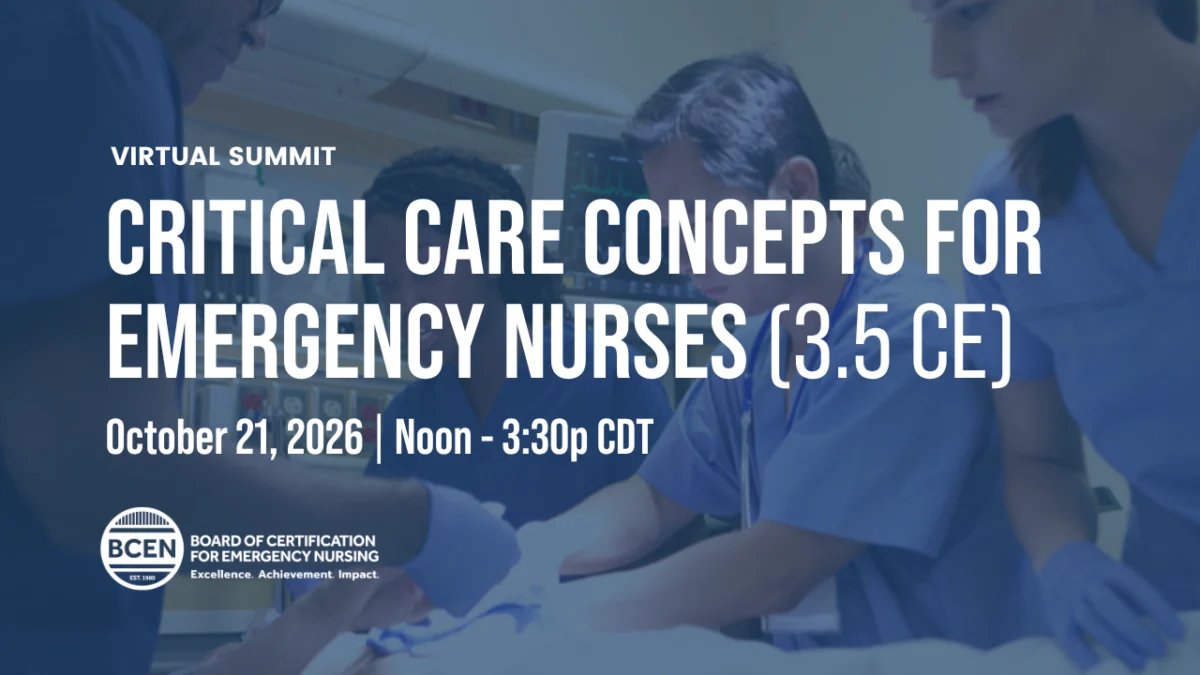
Critical care priorities, resuscitation management, and documentation for emergency nurses. 🚨
This live virtual summit offers a comprehensive learning experience designed for emergency nurses seeking to strengthen their critical care knowledge and clinical decision-making skills. Through four focused presentations, explore essential concepts in early critical care, recognize and manage common complications of resuscitation, prioritize care during critical care transport, and refine documentation practices to support quality patient outcomes and professional accountability.
⏰ Early registration discount: Use discount code ‘SUMMIT‘ at checkout for $10 off your registration! Code expires September 21, 2026 at 11:59pm EDT.
Summit Agenda
📅 Wednesday, October 21, 2026 from 12pm – 3:30pm CDT
Led by experienced clinicians, this interactive event delivers evidence-based insights, practical strategies, and real-world applications that empower emergency nurses to confidently care for the most complex and critically ill patients across the continuum of emergency care.
 |
12-12:50pm CDTCritical Air: Managing Priorities in Critical Care TransportAdam Vilander, MSN, RN, CEN, CFRN, TCRN, CCRN, CHSE, NPD-BC From liftoff to handoff, knowing what comes first can change outcomes. This session explores the unique challenges of critical care transport nursing and the strategies used to manage competing demands across fixed‑wing, rotor‑wing, and ground transport, with real‑world insight into stabilization, advanced interventions, and time‑sensitive emergencies. |
 |
12:50-1:35pm CDTImportant Concepts in Early Critical CareBrady Bielewicz, DNP, CRNP, CNS, RN, CCRN, TCRN, CHSE, CCAPP In this session, attendees will have the opportunity to explore the initial and continuation of the primary and secondary survey for the critically ill trauma patient. From its foundation at the scene, to the trauma bay, emergency department, and intensive care unit – key concepts of trauma care and early clinical signs of decompensation will be reviewed to expand your breadth of knowledge of trauma assessment, diagnosis, and management. Through the alphabet soup of trauma care bundles – participants will feel more prepared to provide efficient and effective critical care to trauma patients across all care areas in those first few, some may say most impactful, hours post-trauma. |
1:35-1:45pm CDTBreak for Questions |
|
 |
1:45-2:30pm CDTComplications of ResuscitationSarah Bernardy, BSN, RN, CCRN, CBRN This session will explore the physiologic impact of under- and over-resuscitation and the complications that can arise from each. It will review key assessment findings, management strategies, and post-resuscitation priorities, while providing insight into the care of critically ill patients during their first days in the intensive care unit. |
 |
2:30-3:15pm CDTCritical and Optimal Documenting Tips and TricksLeslie Mollencop, BSN, RN This session will unpack the weaknesses and vulnerability nurses face when their care is not adequately reflected in the patient’s chart especially when reviewed in a litigation setting. It will teach you valuable skills and crucial reminders to help strengthen and promote good bedside care, assessments and intentionality. It will emphasize the power of being objective and empathetic. |
3:15-3:30pm CDTQuestions and Closing Remarks |
Learning Objectives
- Analyze critical care air transport scenarios to prioritize patient care and transport decisions, applying evidence-based strategies to manage time-sensitive conditions, physiological stressors, environmental challenges, and transport-related risks throughout the continuum of care.
- Evaluate trauma patients in the early post-injury period by identifying key clinical findings, detecting signs of deterioration, and utilizing the tertiary survey to guide comprehensive patient assessment and care.
- Evaluate the effectiveness of trauma and burn resuscitation by interpreting key monitoring parameters, recognizing indicators of over-resuscitation, and applying assessment findings to guide ongoing patient management and optimize outcomes.
- Apply best practices in clinical documentation by identifying documentation vulnerabilities, distinguishing effective and problematic terminology, and integrating strategies that support accurate, defensible, and patient-centered charting.
CE = 3.5
Provider approved by the California Board of Registered Nursing, Provider # CEP17490 for 3.5 contact hour
This session is – Clinical / Accredited