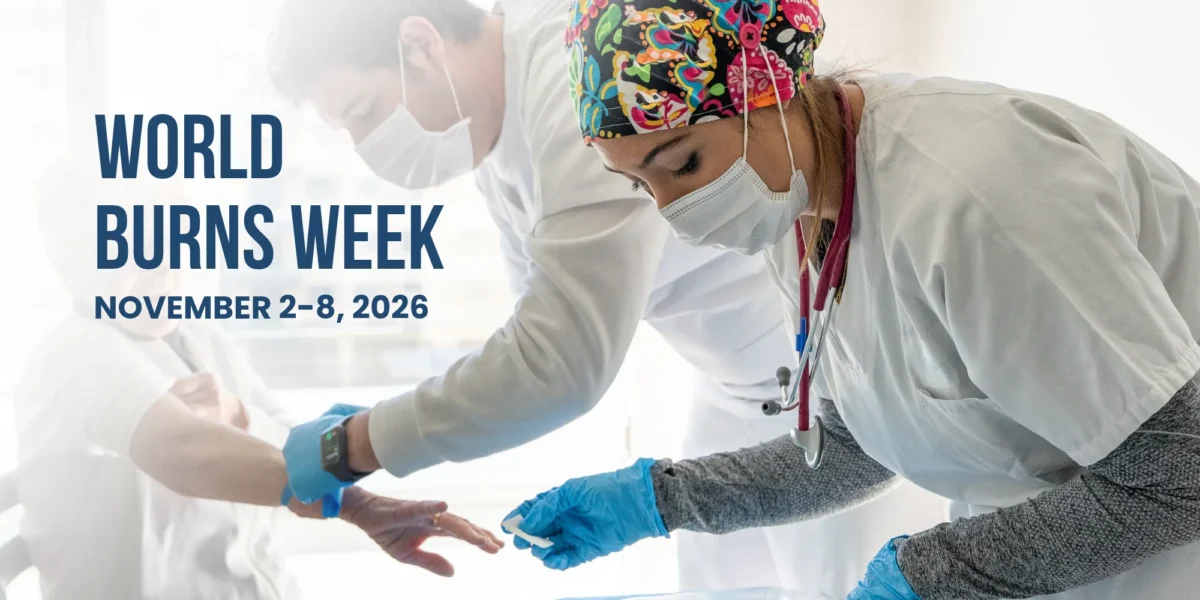
The first week of November marks a special time for those affected by burns. It’s World Burns Week, an international movement aimed at reducing inequalities in burn prevention, burn care, and survivorship. The mission of World Burns Week is to be a unified voice for burns as a global health crisis through advocacy and international collaboration.
We asked three members of the CBRN Exam Construction Review Committee (ECRC) why this week is so significant for burn care teams and burn injury survivors. Hear from Gretchen Carrougher, MN, RN, CBRN, Purvi Patel, DNP, APN, FNP-C, CBRN, and Kiera Earney, BSN, RN, CBRN, CCRN, on what it means to thrive through a community of care.
From a nursing standpoint, what does the transition from surviving to thriving look like on the unit?
Burn nurses have the unique privilege of getting to know the person behind the injury; their family, their fears, their strengths, and what matters most to them.
To me, thriving begins when a patient transitions from being a passive recipient of care to an active participant in their recovery. Early on, our focus is understandably on survival; airway, resuscitation, wound care, pain control, and preventing complications. As patients stabilize, we begin looking beyond the injury and asking, “What does this patient want their life to look like when they leave here?”
One patient who profoundly changed my perspective was given less than a 1% chance of survival and ultimately required quadruple amputation.
Throughout her hospitalization, she pushed herself, leaned on her family and healthcare team, and maintained an incredible determination to move forward.
What has stayed with me most is what happened after she left the hospital. She did not allow her injury to define her. She returned to being a mother, caring for her farm, competing in sports, and became a motivational speaker.
That is thriving.
Her story taught me that thriving does not necessarily mean returning to the life you had before your injury. Sometimes it means building a new life that is meaningful, fulfilling, and your own.
It is also incredibly powerful when burn survivors return as volunteers and mentors. No one understands the road ahead better than someone who has already walked it. They can help newly injured patients navigate challenges and demonstrate what is possible on the other side.
– Kiera Earney, BSN, RN, CBRN, CCRN, Clinical Resource Nurse, Firefighters Burn Institute Regional Burn Center at UC Davis Medical Center

What role does the broader care team, including rehabilitation specialists, social workers, mental health professionals, and family members – the burn patient’s ‘community of care’ – play in helping patients move from recovery to true thriving?
Recovering from life-altering injuries requires an intentional return to achieving goals and finding joy in ways that may look different than they did before the injury. Recovery can be overwhelming for survivors and their caregivers; peer support adds a valuable layer to their community of care.
I believe there are unspoken moments when you can perceive a patient’s sense of pride in themselves, their strength, and their capability to have made it so far. Embracing themselves and their journey opens the door to life beyond their injury.
– Purvi Patel, DNP, APN, FNP-C, CBRN, Advanced Practice Nurse, Burn & Complex Wound Center at UChicago Medicine

What would you tell a nurse just starting in burn care about why this specialty matters on a global scale?
Burn nursing offers tremendous personal and professional rewards. Throughout my 45-year career in burn nursing, it has been a privilege to support patients in their recovery journeys and to continue working with individuals who are now involved in my research efforts. These relationships have reinforced for me that burn care extends far beyond the initial injury; it is about supporting recovery, promoting long-term well-being, and helping people rebuild their lives.
I am deeply grateful to the mentors who helped me recognize the profound impact of this specialty and the value of working alongside dedicated, collaborative burn care teams. Burn injuries are a global challenge, and burn nurses have an important role in advancing care, sharing knowledge, and improving outcomes for patients everywhere.
– Gretchen Carrougher, MN, RN, CBRN, Research Consultant, Northwest Regional Burn Model System, UW Medicine Regional Burn Center at Harborview Medical Center

What does World Burns Week mean to you as a leader in burn nursing?
World Burns Week reminds us that survival is the beginning of the journey, not the destination.
For current and future CBRNs, one of the greatest gifts we can give our patients is to see beyond their wounds. Learn who they are. Ask what matters to them. Help them identify where they want to go and use our burn nursing expertise to bring the team together to help the patient get there.
And when those patients eventually return to help someone else through their journey, we see the true meaning of a community of care: patients become survivors, survivors become mentors, and those we once cared for become part of how we care for the next patient.
– Kiera Earney, BSN, RN, CBRN, CCRN, Clinical Resource Nurse, Firefighters Burn Institute Regional Burn Center at UC Davis Medical Center
What’s one piece of advice for burn nurses and other clinicians engaged in this community of care?
To the healthcare community and particularly burn nurses: We spend our careers giving our all – physical care, emotional support, sharing smiles through the highs and tears through the lows. Take a moment to recognize that you are one of the most special humans and there are lives that would not be the same without you. Thank you for doing all it takes to provide excellent burn care.
– Purvi Patel, DNP, APN, FNP-C, CBRN, Advanced Practice Nurse, Burn & Complex Wound Center at UChicago Medicine
Why is international collaboration among burn nurses so important, and how have you seen that move the needle on health equity in burn care?
International collaboration among burn nurses creates opportunities to share knowledge, learn from diverse experiences, and advance the quality and equity of burn care globally. I recently returned from the International Society for Burn Injuries (ISBI) meeting in Chile, where I witnessed firsthand the value of connecting nurses from around the world. Despite differences in resources and healthcare systems, we share a common commitment to improving patient outcomes.
One promising example is our early work to review and discuss burn nursing competencies developed in North America with international colleagues. These conversations are an important step toward developing a more inclusive, globally informed approach to burn nursing education and practice.
– Gretchen Carrougher, MN, RN, CBRN, Research Consultant, Northwest Regional Burn Model System, UW Medicine Regional Burn Center at Harborview Medical Center
Thank you to Kiera, Purvi, and Gretchen for being such dedicated trailblazers in the burn nursing specialty.
Go Deeper
BCEN is proud to partner with the American Burn Association (ABA) and Phoenix Society for Burn Survivors, two of World Burns Week‘s regional representative organizations.
Interested in burn nursing? Learn more about CBRN certification and what it takes to specialize.