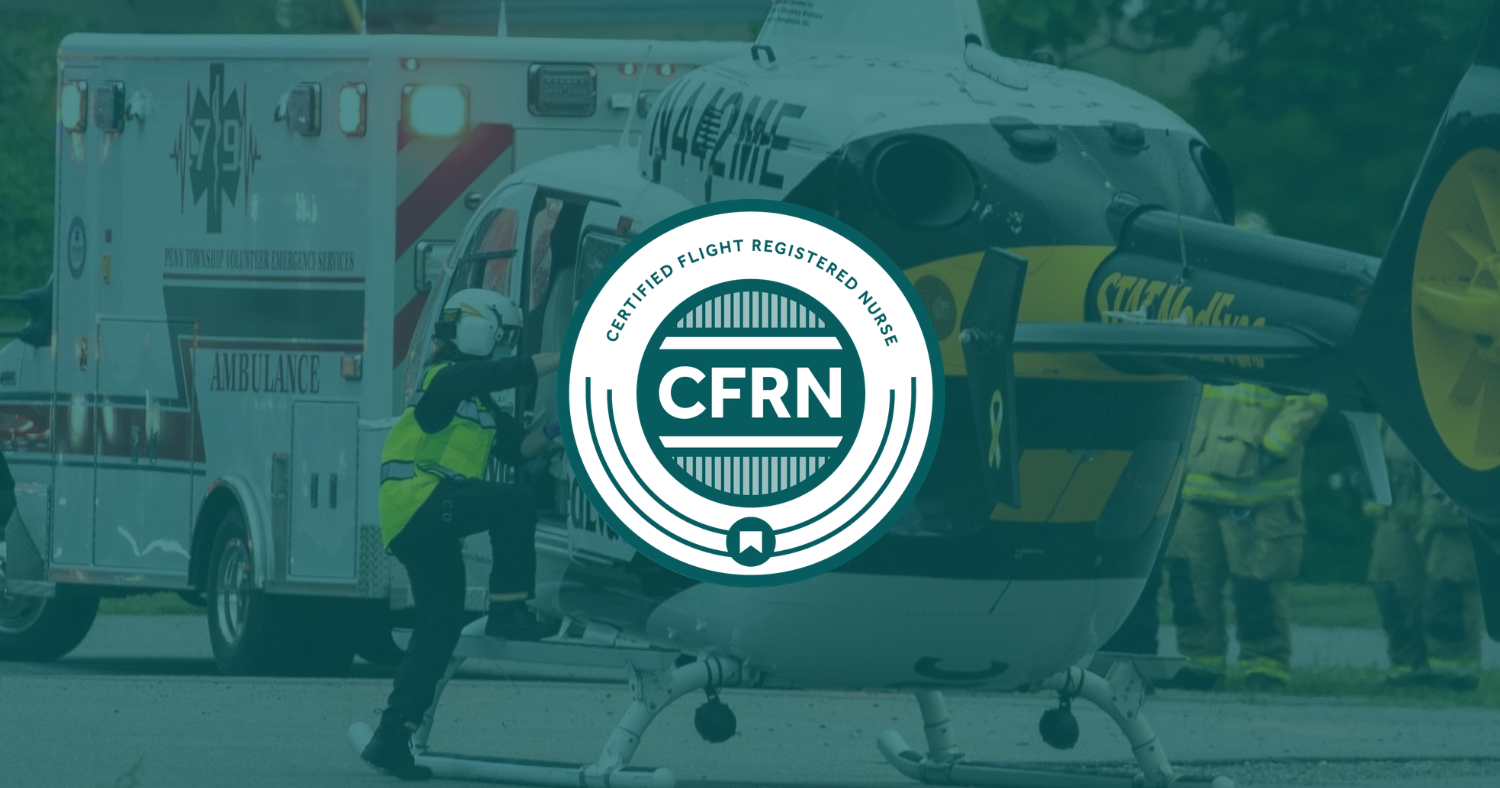
Evolving Excellence: Updating the CFRN Exam
In this edition of Evolving Excellence: Get all the need-to-know details about the upcoming updates to the CFRN exam content outline. Plus, expert commentary on the evolving practice of flight nursing with 2025 Flight Nursing Role Delineation Study (RDS) Advisory Committee members Nyssa Hattaway and Lacie Thuren.
The updated CFRN exam content outline goes into effect on August 31, 2026.
A Commitment to Keeping Certification Current
The 2025 Flight Nursing RDS and exam update are part of an extraordinary period of work at BCEN, with four role delineation studies conducted across four specialties (trauma, ground transport, emergency and flight) in just the past two years. This sustained effort reflects BCEN’s deep commitment to the quality and integrity of its exams. As BCEN’s Amy Grand, MSN, RN, ICE-CCP, said:
“I’m incredibly proud of BCEN’s commitment to keeping our exams current, valid, reliable, and reflective of real-world specialty practice across the country—but just as important is the exceptional dedication of the BCEN community.
Conducting four role delineation studies in such a short time is no small undertaking, and the response we saw, with nearly 100 nurses applying to participate in the CFRN RDS alone, speaks volumes about that commitment.”
Expert Perspectives: Flight Nursing Practice Today
BCEN asked 2025 Flight Nursing RDS Advisory Committee members and Air Methods flight nurses Nyssa Hattaway, BA, BS, RN, CEN, CPEN, CFRN (Atlanta, Georgia) and Lacie Thuren, BSN, RN, CFRN, CTRN, CCRN (Visalia, California) to share their experiences and perspectives.
Now that the RDS is behind you, what one thing stuck out for you about today’s flight nurses and flight nursing today?
Nyssa: The main thing that resonated with me is that flight nursing is moving beyond “simply” transporting the patient to a mindset that encompasses treating and transporting them in a way that considers the best definitive care, the patient’s projected plan of care, and even their discharge. Patients are sicker and more complex, and therefore we have more resources to care for them in flight and make decisions about getting them quickly to definitive care. Advanced ventilators, mechanical circulatory devices, diagnostic ability (such as point-of-care ultrasound and labs), and whole blood assist us in resuscitating the critically ill and injured while efficiently getting them to a specialty center for care.
Lacie: What stuck out to me is just how different each base or area we serve can be. Not every base or average patient population will be the same, so not every flight nurse will have the same strengths or weaknesses. The profession requires us to be a jack-of-all-trades, so setting a standard is important to be prepared for whatever we are presented with—even when it’s outside of our average call.
Based on the RDS data, what autonomous or independent clinical decisions are today’s flight nurses most often making that have the greatest impact on a patient’s trajectory during transport?
Lacie: Independently deciding when to manage an airway on critically ill patients is one of the biggest responsibilities. Within that, knowing how to safely prepare a patient, or potentially delay that procedure until the patient is stable enough with resuscitation, can drastically change a patient’s trajectory. Making the decision to intubate a patient is more complicated than just placing an endotracheal tube.
Nyssa: We continue to emphasize the “resuscitate before you intubate” mindset as well as treating hemorrhagic shock patients with blood products (preferably whole blood, which more flight services are carrying). Because we manage airways in austere environments, we will always focus on improving intubation success rates, preventing hypoxia and hypotension, and managing ventilation in the pre-hospital environment. Advanced ventilators, sophisticated SIM lab training, recording intubations for quality assurance, and cadaver labs are key to this goal.
Thinking broadly, what advances, changes, or shifts in attitudes and philosophies have been impacting how the flight nursing specialty has evolved over the past 4-5 years?
Nyssa: We are moving further away from the idea that we are transport support to the idea that we are truly delivering mobile critical care that can significantly impact patient outcomes with advanced diagnostics, management of complex circulatory support devices, and independent plan of care decision-making.
Lacie: Medicine is always advancing, so it’s important for us as flight nurses to stay up to date on best practice, new procedures and equipment. This requires accountability to stay fresh and be willing to continue learning. Flight is a more niche area of nursing, and more education and transparency has allowed others to understand just how much autonomy we have—as well as the accountability that the position requires.
The number of flight nurses has continued to grow at a very healthy rate. Why do you think that is the case?
Lacie: The industry is moving away from the dated mentality that flight should only be used for saving time, and more communities realize just how valuable flight nurses are. With our advanced scope, we can truly bring the hospital to the field or continue lifesaving equipment and medication administration from hospital to hospital.
Nyssa: Flight nursing continues to grow as an industry because the evidence increasingly shows that patient outcomes improve with early access to stroke, cardiac, trauma, burn and specialty pediatric care. Air medical fills the gap between access in both the rural and urban settings—whether distance or infrastructure are the barrier to care. Patient care is more specialized and regionalized, so the demand for critical care clinicians in transport continues to grow.
What Nurses Need to Know About the Updated CFRN Exam: What’s In, What’s Out & Changes to the Exam Content Outline
The updated CFRN exam content outline goes into effect on August 31, 2026. (For complete details, visit the CFRN Study and Prepare page.)
Several topics have been added or removed from the exam. Also highlighted below are some noteworthy organizational changes to the exam content outline.
| What’s In | What’s Out* | |
| Exam Topics |
|
|
*Topics may be removed because they are not specific to just to the flight setting, not a primary reason for a flight transport, or the RDS survey indicated very low frequency or significance for flight nursing/flight transports.
The Experts, Supporters and Participants Behind the 2025 Flight Nursing RDS
In 2025, BCEN convened a distinguished panel of flight nursing experts to spearhead a flight nursing RDS—a rigorous, every-five-years industry best practice that outlines the scope of knowledge required for competent practice in the specialty and thereby ensures the Certified Flight Registered Nurse (CFRN) exam is accurate, current and valid.
The 12-member Flight Nursing RDS Advisory Committee—which consisted of CFRN-certified transport nursing experts from air medical transport programs based in urban, community or university-affiliated hospitals—collectively brought more than 128 years of nursing experience and 75 years of flight nursing experience to the process.
407 certified and non-certified nurses working in the air medical setting completed the RDS survey.
BCEN is grateful for the time, experience and contributions of the esteemed members of the 2025 Flight Nursing/CFRN RDS Advisory Committee. Each member is a certified flight nurse working in community-based, hospital-based, or academic-affiliated transport programs with experience on rotor- and fixed-wing aircraft.
2025 Flight Nursing/CFRN RDS Advisory Committee
- Stephanie Bittner, Med-Trans Corp (Sumter, SC)
- Ryan Bolger, PHI Air Medical (Baltimore, MD)
- Kathryn Calmeyn, UCAN – University of Chicago Aeromedical Network (Chicago, IL)
- Derek Collins, PHI Air Medical, (Baltimore, MD)
- Kent Cramer, Stanford Health Care, (Stanford, CA)
- Jeri Ennis, Atlantic Mobile Health (Florham Park, NJ)
- Keeley Enos, Air Evac Lifeteam (Ada, OK)
- Nyssa Hattaway, Air Methods, (Atlanta, GA)
- Micah Klaas, STAT MedEvac (West Mifflin, PA)
- Scarlett Lucurto, Ochsner Flight Care (New Orleans, LA)
- Dana McGuire, Life Flight Network (Dallesport, WA)
- Lacie Thuren, Air Methods (Visalia, CA)
BCEN is also grateful to the Air & Surface Transport Nurses Association (ASTNA) for their support in promoting the RDS survey.
Thank You RDS Survey Participants!
To every nurse who participated in the RDS survey: Your input is essential and invaluable. Thank you for your commitment and for being a pivotal part of advancing flight nursing specialty practice!
For more information about role delineation studies and recent exam updates, visit the CEN, TCRN and CTRN editions of the Evolving Excellence series.
How to Take the CFRN Exam
Ready to achieve the highest-level flight nursing credential and get CFRN certified? Learn more about CFRN certification or contact BCEN.
More from our Evolving Excellence Series
Evolving Excellence: Updating the CEN Exam (Certified Emergency Nurse)
Evolving Excellence: Updating the CTRN Exam (Certified Transport Registered Nurse)
Evolving Excellence: Updating the TCRN Exam (Trauma Certified Registered Nurse)